
Welcome to the third edition of Field Notes, a quarterly newsletter from EdenTree’s Sustainable Investment team.
As EdenTree’s lead on engagement, I’m going to kick off our third edition by reflecting on a summer of weather extremes and introducing some of the stewardship work we have in the pipeline. As September brings cooler weather and a renewed ‘back to school’ energy, we are engaging across our core priorities on topics ranging from improving access to financial services to encouraging chemical manufacturers to phase out ‘forever chemicals’.
In this edition, we examine what this summer’s droughts reveal about the true value of water and the growing importance of climate adaptation. We also spotlight our upcoming engagement work, explore how insurance policies can help constrain coal expansion, assess contrasting trends in stewardship and ask whether AI governance is keeping pace with adoption.
We hope you enjoy the read. As always, we’d love to hear from you with any feedback, questions, or topics you’d be interested in seeing explored in future editions, so please get in touch.
Thought leadership: the high cost of cheap water
As an island nation famed for our drizzle and grey skies, we in the UK tend to think of water as an abundant resource. Our national pastime of complaining about the weather only reinforces the perception that water is everywhere, creating an inherent conflict between how we value water and the reality of its supply.
But after a record wet winter, we have been reminded that rainfall doesn’t necessarily protect us from a dry summer. Rain can arrive in the wrong place, at the wrong time or too intensely to replenish the rivers and reservoirs on which we depend. By mid-August, 71% of England by land was in drought and reservoir storage had fallen to 62.6%. More than 1,500 abstraction-licence restrictions were also in place, adding to the pressure on farmers already contending with poor crop yields and reduced grass growth1.
Public frustration with hosepipe bans has been palpable. After being asked to use less water around their own houses, people are rightly pointing to large-scale leakage, pollution, financial mismanagement and years of inadequate oversight. Higher bills are particularly difficult to accept without visible improvements in service and environmental performance. But justified anger at the system does not remove the underlying constraint: water has historically been consumed, priced and managed as though supply were infinite.
The consequences of physical water risk extend well beyond UK water shortages. Across Europe, extreme heat, drought and low river levels have disrupted agriculture, energy and transport. Drought has once again proved that water scarcity is a balance-sheet issue, affecting both operating costs and the long-term viability of assets in exposed locations.
Building resilience will require more than repairing leaks or constructing reservoirs. It means reconsidering how water abstraction licences are allocated and managed, determining who can take water from rivers and reservoirs, and in what volumes. It also means reducing demand and expanding water reuse. Alongside this, fairer payment models are needed to protect vulnerable households while better reflecting scarcity and supporting long-term investment.
Water, and its responsible management and valuation, remains an important focus of our stewardship. Through engagement, we encourage companies to understand their exposure and build resilience across their operations and supply chains.
As the UN has warned, we are living in an era of water bankruptcy after exceeding our hydrological means for too long2. With a strengthening El Niño potentially adding further volatility to global temperatures and rainfall patterns, the social and economic impacts witnessed this summer should be treated as a warning. Closing the gap between perceived and actual supply will require us to value water appropriately and to recognise that its sustainable management is fundamental to the resilience of communities and economies.
Engagement & voting: in brief
From progressing our thematic engagement priorities to strengthening impact in public markets, our stewardship work this quarter centred on long-term structural sustainability themes.
- Strengthening impact through engagement: A key area of focus this quarter has been the continued development of our impact engagement programme across equities, fixed income and infrastructure. While each strategy has distinct priorities, a common theme has been improving the quality of impact evidence, measurement and disclosure, enabling investors to better understand not only who is being reached, but the outcomes being delivered.
Within fixed income for example, our engagements have increasingly focused on strengthening the impact integrity of social and green bond issuers. Through discussions with issuers such as OneMain Financial and Places for People, we have encouraged a shift beyond simple reach metrics towards more outcome-focused reporting that demonstrates the real-world benefits experienced by customers and communities. We have also engaged green bond issuers, including Xylem, on opportunities to enhance use-of-proceeds frameworks and disclosures, seeking greater clarity on how financed activities contribute to environmental outcomes before capital is deployed.
Through this work across all strategies, we aim to ensure that stewardship supports both improved company practice and stronger long-term impact outcomes for investors and society. - Engagement insight: In the second half of 2026, we are continuing to progress several of our thematic engagement programmes. These include the second year of our financial inclusion initiative, focused on how UK building societies can improve the affordability of financial products and widen access to fair credit, the third year of our work with chemicals companies on water stress and the phase-out of PFAS and the continued delivery of our Climate Stewardship Plan, focused on credible net-zero strategies and real-world decarbonisation.
Each addresses a distinct challenge, but together they reflect a growing need for resilience. Households continue to navigate cost-of-living pressures, while a summer of extreme heat and water restrictions has brought environmental pressures closer to home. These experiences provide a timely backdrop to our engagement, as we encourage companies to anticipate material risks, strengthen resilience and support a transition that delivers meaningful outcomes for people and the planet.
For more examples of our recent stewardship activity, head to our quarterly Sustainable Investment Activity and Proxy Vote Reports.
On our radar
Topical news and research that has caught the team’s eye:
- Engage with the insurance sector to reduce support for coal expansion? The recent ShareAction insurance benchmark evaluates the policies and disclosures of 40 major property and casualty insurers across climate, biodiversity and social issues. The report paints a picture of slowing progress in recent years, with adoption of new fossil fuel and biodiversity commitments largely stalling since 2024 and significant variation remaining in areas such as nature-related risk management. Of particular interest was the finding that insurers with formal coal restrictions reduced the number of coal mines they insured by 16% and the volume of insured coal by 56%. The study also found that mines losing insurance coverage were more likely to be scaled down or abandoned. Given that insurance is often a prerequisite for project financing, this evidence suggests that underwriting policies can play an important role in constraining coal expansion alongside more familiar engagement efforts targeting banks and other providers of capital.3
- Is stewardship expanding or contracting? In the past few months, we have seen Morningstar close its stewardship office while proxy advisor Glass Lewis has expanded its stewardship offering, highlighting the differences in approaches we are seeing to stewardship on the market. Geopolitical pressure and increased dissonance between companies and shareholders have led to some asset managers to take a step back from company engagement, while legal pressure from the US administration has also ensured some larger managers withdrew from collaborative engagement. While this could imply a reduction in focus on stewardship, these trends are not experienced equally across the market, and we are encouraged to see a renewed focus on engagement outcomes over volume and greater linking of financial materiality to engagement objectives in many areas of the market.
- AI adoption is outpacing governance: While organisations are increasingly embedding AI into operational processes and decision-making, oversight arrangements are not evolving at the same rate. Recent research from the Chartered Governance Institute UK & Ireland (“CGI”)4 pointed to a lack of visibility for Boards over where AI is being used, how it is influencing decisions, and whether appropriate controls are in place. In the US, EY’s latest AI Risk and Governance Survey, conducted with senior AI decision makers at US-listed companies, found that 91% were already piloting or using agentic AI, yet 49% said their governance frameworks had not been updated to cover agentic AI risks or requirements5. As AI systems begin to take actions with limited human involvement, we will be watching for evidence that companies’ governance arrangements are keeping pace with the increasing risk exposure.
On point: “Entering an era of 1.5oC overshoot” - UNEP
The UNEP’s report “Limiting Overshoot: Navigating exceedance of 1.5°C and pathways towards return” 6 has garnered a lot of attention in the media, not least due to the acknowledgement that a 1.5°C scenario is no longer attainable without various forms of carbon removal.
The report argues that we have entered an era defined by overshoot limitation. For Small Island Developing States and low-lying countries in particular, addressing the associated risks will require a level of multilateralism and acknowledgement of historical responsibility that the international community has thus far struggled to achieve.
We believe the growing urgency of adaptation warrants greater investor attention. The topic has been gaining traction for some years, and we are considering it more within our own assessment processes and engagements in areas such as water stress.
But adaptation is as much a social issue as a question of environmental infrastructure. Climate adaptation is often hindered not by a lack of local knowledge, but by the failure to recognise and empower those who possess it. For example, in many parts of the Global South, women frequently hold critical knowledge relating to water management, agriculture, biodiversity and community resilience. Economic and social barriers, however, can prevent this knowledge from shaping adaptation decisions. The evidence increasingly suggests that empowering women isn’t just a social objective, but a practical adaptation strategy that improves resilience outcomes for communities and countries alike.
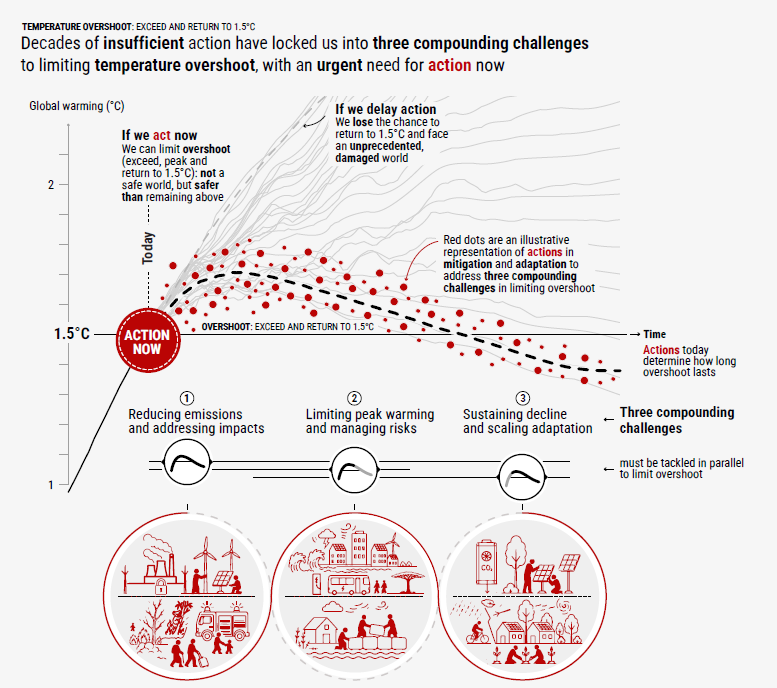
Source: UNEP Report - Limiting Overshoot: Navigating exceedance of 1.5°C and pathways towards return
Sources
- Dry weather and drought in England: 14 to 20 August 2026
- Global Water Bankruptcy
- Insuring Disaster 2026: ShareAction’s assessment of 40 of the world’s largest insurers
- Equipping Governance Professionals to Lead AI Conversations
- EY survey finds that autonomous AI implementation outpaces oversight, yielding an AI governance gap
- Limiting Overshoot: Navigating exceedance of 1.5°C and pathways towards return