
How fundamental research, valuation discipline and stock selection shape the EdenTree Sustainable European Equity Fund
- Chris Hiorns, Head of European Equities
Sustainable investment strategies are often criticised for prioritising environmental and social considerations at the expense of investment performance.
Yet, we believe this criticism masks an important distinction. For Europe excluding the UK, recent analysis has shown the variation in performance between sustainable and non-sustainable strategies – specifically, the effect of sector exclusions – was not a consequence of the exclusions themselves. In fact, our analysis (shown below) suggests that sustainability exclusions had a broadly neutral impact on the performance of the European ex UK market* over longer periods.
| MSCI Europe ex UK: GICS Sectors | Benchmark Weight | Attribution Effect YTD | Attribution Effect 3 Months | Attribution Effect 1 Year | Attribution Effect 3 Years | Attribution Effect 5 Years |
|---|---|---|---|---|---|---|
| Aerospace & Defense | 4.1% | 0.4% | 0.0% | 0.7% | -1.1% | -1.6% |
| Oil & Gas | 3.4% | -0.8% | 0.0% | -0.7% | 0.0% | -1.3% |
| Automobile Manufacturers | 1.4% | 0.5% | 0.1% | 0.6% | 1.4% | 1.0% |
| Alcohol | 1.2% | 0.0% | 0.0% | 0.1% | 0.8% | 0.9% |
| Metals & Mining | 0.5% | -0.1% | 0.0% | -0.2% | -0.2% | -0.1% |
| Passenger Airlines | 0.2% | 0.1% | 0.0% | 0.1% | 0.1% | 0.0% |
| Casinos & Gaming | 0.1% | 0.0% | 0.0% | 0.0% | 0.1% | 0.2% |
| Tobacco | 0.0% | 0.0% | 0.0% | 0.0% | 0.0% | -0.1% |
| Sustainability Excluded Sectors | 10.9% | 0.1% | 0.2% | 0.6% | 1.1% | -1.1% |
Source: EdenTree, 31 August 2026. *The MSCI Europe ex UK Index has been used as a proxy for the European ex UK equity market. Table showing the attribution effect of sustainability excluded sectors. The table shows that excluding these sectors has had a broadly neutral effect over the time periods shown.
If it is the case that sustainability exclusions haven’t had a significant effect on the performance of the MSCI Europe ex UK Index over the past five years, then how can the difference in performance between sustainable and non-sustainable European strategies be explained?
This is where investment style comes in. Many sustainable European strategies have a strong bias towards growth companies due both to the effect of sustainability exclusions and the prevalence of ‘thematic’ investment. Many growth companies have traded at extremely high premiums compared to the rest of the market and have faced a more challenging backdrop over the last five years due to higher inflation and interest rates.
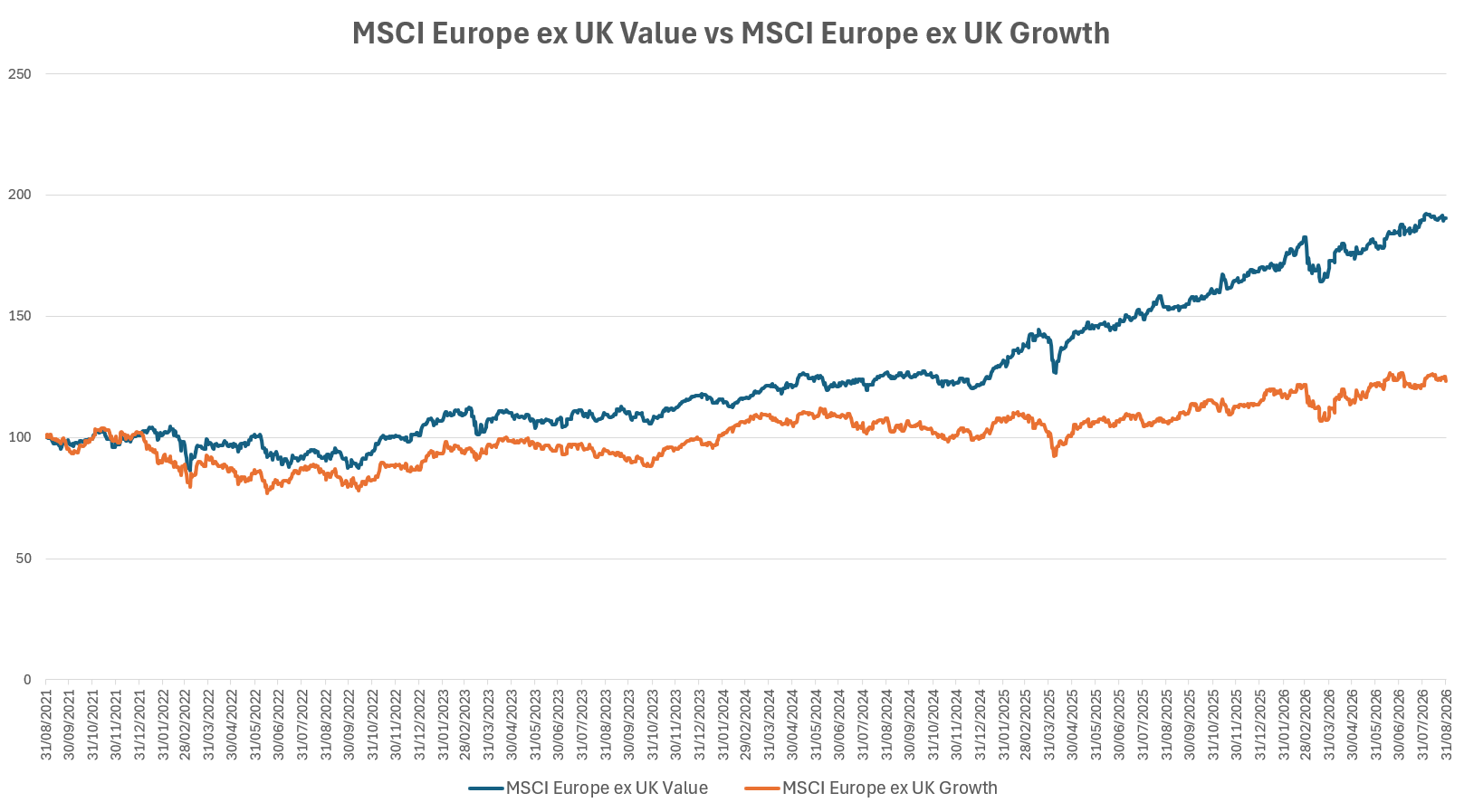
Source: EdenTree. The performance of the MSCI Europe ex UK Value Index and the MSCI Europe ex UK Growth Index over the past five years to 31 August 2026. The MSCI Europe ex UK Value Index has outperformed the MSCI Europe ex UK Growth Index since early 2022.
We, therefore, believe the more important question is not whether sustainable investing is compatible with investment returns, but whether investors have mistaken the effects of a growth-versus-value bias for a sustainability one.
By combining sustainability standards with a rigorous, valuation-orientated approach to stock selection, we believe it’s possible for investors to achieve both their sustainability goals and long-term investment returns. The experience of the EdenTree Sustainable European Equity Fund illustrates how this philosophy is applied in practice, with fundamental research, valuation discipline and individual stock selection at the heart of its approach.
The growth versus value question
Many European sustainable strategies exhibit a bias towards growth companies, with businesses operating in areas such as tech, healthcare and industrial innovation often scoring favourably on sustainability criteria. However, this bias isn’t simply the result of fund managers favouring growth stocks. It is also a consequence of the shape of the investable universe that remains after sustainability exclusions have been applied.
Many sectors commonly excluded, such as oil & gas, tobacco, mining, alcohol and defence, have historically been associated with value investing; these businesses are often in mature industries with lower growth expectations and lower valuation multiples. As a result, excluding them removes a significant portion of the overall market’s cheapest stocks and increases the valuation profile of the remaining investment universe. By contrast, sectors that typically remain within the sustainable universe tend to command higher valuations and have stronger growth characteristics.
In other words, many sustainable investors aren’t simply choosing growth stocks. By excluding parts of the market that tend to be cheaper and more value-oriented, investors are left fishing in a pool that is skewed towards businesses trading on higher valuations.
This distinction is important because investment styles move in and out of favour over time. Following a prolonged period of growth leadership, the inflationary environment of 2022 and 2023 triggered a resurgence in value stocks in Europe, with these businesses benefitting from higher commodity prices, rising interest rates and a changing economic backdrop. Growth-oriented European companies, by contrast, faced a more challenging environment.
Against this backdrop, some investors concluded that sustainable investing had become a headwind to performance. Yet we believe this may oversimplify the factors at play. Investors may have been observing the effects of a growth-versus-value cycle, rather than the consequences of a sustainable investment approach.
Which leads us to an important point: sustainable investing doesn’t have to mean growth investing. While some sustainable strategies apply exclusions and then invest across the remaining universe, the Edentree Sustainable European Equity Fund takes a different approach. We actively search for the most attractively valued opportunities within the remaining universe, focusing specifically on sustainable businesses whose long-term prospects are not fully reflected in their share prices.
Our European case study
The experience of the EdenTree Sustainable European Equity Fund demonstrates that sustainability and value investing are not mutually exclusive. The Fund has delivered strong relative performance, returning 14.5% from January 2026 to end August 2026 compared with 9.8% for the MSCI Europe ex UK Index. The Fund is also ranked in the first quartile of the IA Europe excluding UK sector over one, three, five and ten years to end August 2026.
| Cumulative performance (as of 31.08.2026) |
YTD | 1 Year | 3 Years | 5 Years | 10 Years |
|---|---|---|---|---|---|
| Fund Performance (B Class) | 14.5% | 24.5% | 64.6% | 77.1% | 184.2% |
| MSCI Europe ex UK NR GBP* | 9.8% | 19.4% | 50.2% | 53.9% | 164.5% |
| IA Europe Excluding UK Sector | 10.0% | 17.6% | 45.4% | 42.8% | 138.6% |
| Sector Quartile | 1 | 1 | 1 | 1 | 1 |
Source: Morningstar
Fund, Index and Sector performance reported in GBP. As the Fund invests in a diverse range of European (ex UK) companies and sectors, we compare the Fund’s performance to the MSCI Europe ex UK GBP Net Total Return Index. However, the portfolio manager is not bound or influenced by the index when making investment decisions. Fund performance calculated on a net total return NAV to NAV basis with net income reinvested into the Fund. Past performance should not be seen as a guide to future performance. *The MSCI Europe ex UK GBP Net Total Return Index was adopted as the Fund’s comparative benchmark on 1 January 2024, replacing the FTSE World Europe ex UK Index.
Central to the Fund’s philosophy is its valuation discipline. Rather than pursuing growth at any price, the investment team focuses on identifying high-quality businesses whose long-term prospects are not fully reflected in their share prices. This creates opportunities to invest in companies that meet EdenTree’s sustainability criteria while also offering compelling risk-adjusted return potential.
Importantly, stock selection rather than sector positioning has been the dominant driver of returns for the Fund during a one year, three year and five-year period. This is a crucial distinction – if sustainability exclusions were the primary determinant of outcomes, we would expect performance to be driven by what the Fund does not own. Instead, the evidence points to the businesses selected within the investable universe being a more important contributor to returns for the Fund.
Over 2026 to the end of August, holdings such as Mersen, Siltronic and Nokia were among the strongest contributors to performance. In each case, the investment case was not rooted just in sustainability credentials, but in the combination of attractive valuations, improving earnings prospects and favourable long-term fundamentals.
Perhaps most importantly, the Fund’s performance suggests that rigorous sustainability standards and valuation-aware investing are not competing objectives, but complementary disciplines.
A value-aware approach to sustainable investing
The experience of recent years suggests that discussions around sustainable investing may have overlooked the role of investment style.
For investors willing to apply valuation discipline, sustainability need not be a constraint on performance. The returns of the Sustainable European Equity Fund have not come from chasing fashionable growth themes, but from identifying attractively valued businesses capable of delivering sustainable long-term growth.
The debate around sustainable investing is often centred around what investors exclude. Yet the evidence presented here suggests that our long-term outcomes have been determined far more by what we chose to own.
Discrete Performance
| Discrete performance (as at 31.08.2026) |
August 25 – August 26 | August 24 – August 25 | August 23 – August 24 | August 22 – August 23 | August 21 – August 22 |
|---|---|---|---|---|---|
| Fund Performance (B Class) | 24.51% | 15.48% | 14.49% | 21.52% | -11.44% |
| MSCI Europe ex UK NR GBP* | 19.41% | 9.30% | 15.08% | 15.84% | -11.52% |
| IA Europe ex UK | 17.59% | 8.70% | 13.71% | 14.36% | -14.08% |
Source: Morningstar
Fund, Index and Sector performance reported in GBP. Fund performance calculated on a net total return NAV to NAV basis with net income reinvested into the Fund. Past performance should not be seen as a guide to future performance. *Prior to 1 January 2024, the Index was the 'FTSE World Europe ex UK total Return GBP'.
Important Information
This document has been prepared by EdenTree Investment Management Limited and has been produced for information purposes only. As such the views contained herein are not to be taken as advice or recommendation to buy or sell any investment or interest thereto. These are the views of the author at the time of publication and may differ from the views of other individuals/teams at EdenTree Investment Management. The views presented are as of the date published.
References to specific stocks are for illustrative purposes only and do not represent a recommendation to buy or sell any securities. The holdings referenced are part of a broader, diversified portfolio and do not represent the full portfolio.
No forecasts can be guaranteed and there is no guarantee that the information supplied is complete or timely, nor are there any warranties with regard to the results obtained from its use. Edentree is the source of data unless otherwise indicated.
Capital at risk. The value of an investment and the income from it may go down as well as up and the investor may not get back the amount initially invested. Selecting stocks due to our ethical criteria means that the choice of stocks is limited to a subset of the stock market and this could lead to greater volatility.
The sector attribution analysis included above reflects only the impact of commonly excluded sectors and should not be viewed as a comprehensive measure of the performance effects of sustainable investing. It does not capture stock-specific sustainability decisions, stewardship activities, governance assessments or company-level exclusions. Sustainable investing is ultimately implemented through a combination of portfolio construction, stock selection and active ownership, not solely through sector screening.
This financial promotion is issued by EdenTree Investment Management Limited (EdenTree) Reg. No. 2519319.
Registered in England at Benefact House, 2000, Pioneer Avenue, Gloucester Business Park, Brockworth, Gloucester, GL3 4AW, United Kingdom. EdenTree is authorised and regulated by the Financial Conduct Authority and is a member of the Investment Association.
Firm Reference Number 527473.
Phone 0800 011 3821
Email clientservice@edentree.com
Edentreeim.com