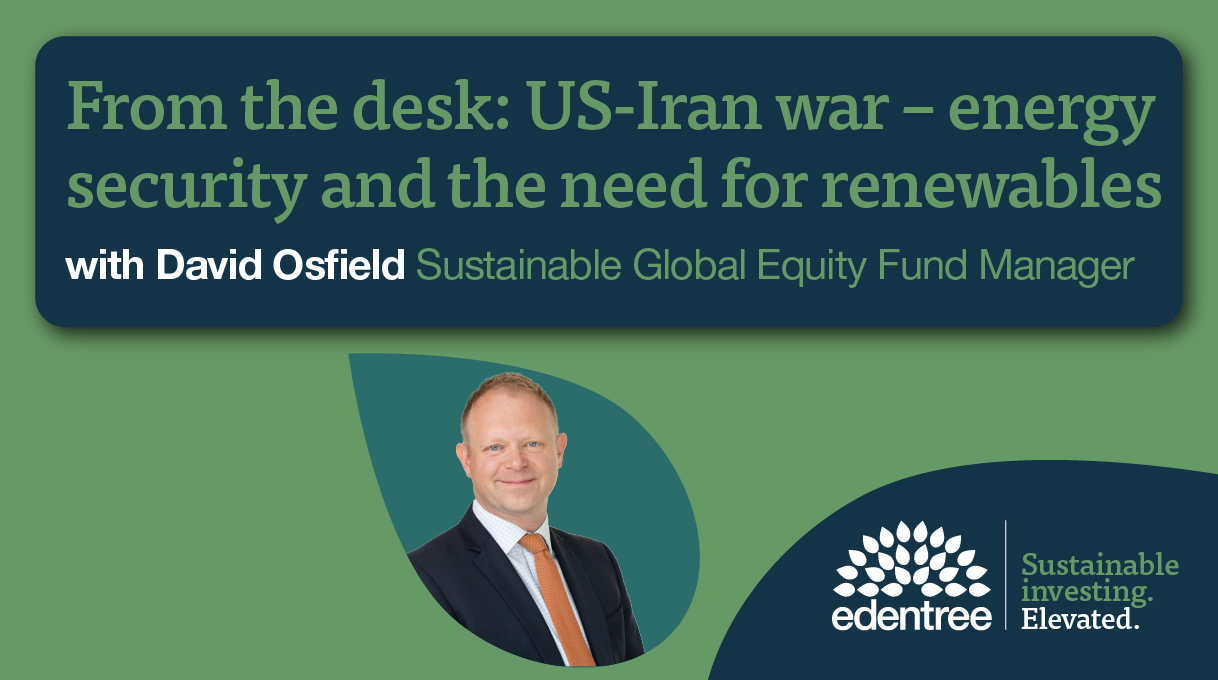

Ceasefire or not, global energy markets face prolonged supply pressure
The Iran war has again brought global energy markets into focus, reigniting inflation concerns and forcing policymakers to confront a familiar vulnerability: the world’s continued dependence on concentrated fossil fuel supply routes.
At the centre lies the Strait of Hormuz, one of the most strategically important chokepoints in the global energy system. As many are aware now, roughly 20% of the world’s oil supply passes through this shipping lane, with any disruption having dramatic consequences for global oil prices. Much of the world now faces a meaningful shortfall, with an estimated 17 million barrels per day that would normally pass through the Strait failing to make it to market1.
Despite enormous emergency reserves being tapped aggressively, the physical throughput – flow of barrels per day – remains constrained. Insurers are treating the Strait as effectively uninsurable, with premiums nearing 5% of vessel value, signalling elevated and persistent risk2. If insurance premiums remain elevated because of the continues risks of attack on vessels in the Strait, this could constrain tanker flow. The net impact would be higher oil prices for longer. Arguably more importantly, we could be operating in a world where disruption to the by-products of refining – such as helium, sulphur and other industrial hydrocarbons – creates significant supply-chain bottlenecks across the wider economy, particularly for sectors such as technology and chemicals.
Inflationary pressures and central bank reactions
Markets initially reacted to this conflict in a sanguine manner. Market consensus still rests on the assumption that the conflict will be short-lived, supported by the behavioural notion that Trump would reverse course if markets deteriorated, aka the TACO trade. However, markets have increasingly realised it take two to TACO. It is likely that insurers, logistics providers and shipping companies would need evidence of cast-iron safety before committing capacity back into the Strait. This combined with the technical challenges of restoring production is likely to delay normalisation well into the summer.
The effects on inflation and demand could be significant: this would be a cost-push inflation shock, not the demand-pull dynamic that central banks are more equipped to manage. If central banks decide to raise rates, it won’t fix the supply bottleneck, but it risks amplifying economic weakness at a time when US financials conditions are already tightening. This could result in stagflation: slower growth paired with supply-driven price pressures.
Policymakers thus face a difficult balancing act, trapped between the need to support growth and the limited utility of monetary tools to address supply-side shocks. Against this challenging backdrop, investors need not only resilience but clarity on where supply-chain bottlenecks may manifest and where opportunities for long-term structural growth remains intact.
The opportunity in renewable energy infrastructure
In response to heightened geopolitical volatility and tightening financial conditions, we believe a defensive stance is warranted. Having delivered exceptionally strong returns, we have reduced our exposure to the technology sector, with the industry facing both energy-cost headwinds as well as Iran-induced supply chain disruption from key input materials. Our exposure to semiconductors in particular has been dialled back, reflecting our concerns that higher energy prices could delay or even cancel data-centre expansion plans – we have materially reduced our holdings in both Taiwan Semiconductor and Chroma ATE after holding both continuously since 2017.
In contrast, we continue to see opportunity in renewable energy, particularly companies building the infrastructure required to provide energy security. Renewables are a fast, scalable and cost-effective response to the energy security challenges now intensifying across the world.
We hold Hannon Armstrong, a US leader in financing climate-positive infrastructure. Hannon Armstrong operates at the intersection of three defining forces: the rapid scale-up of renewable generation essential for energy security; the unprecedented energy requirements of the AI-driven data-centre boom; and the need to close infrastructure funding gaps. We believe this combination positions Hannon uniquely for long-duration growth, underpinned by contracted cash flows and exposure to essential assets.
Alongside Hannon, our holdings SSE and Enel represent two of Europe’s most significant operators and developers of renewable infrastructure. Both companies bring substantial, diversified pipelines to a continent focused urgently on reducing external energy dependencies. Enel, in particular, continues to operate one of the largest renewable pipelines in Europe, supporting meaningful future capacity gains. SSE’s ongoing investment in offshore wind and grid expansion similarly plays a central role in strengthening UK and European energy resilience.
Energy independence is no longer an aspiration but a necessity. In a volatile environment where markets increasingly value visibility, long-duration contracts and resilient cash flows, these holdings offer a compelling combination of defensiveness and structural growth.
The challenge of trading geopolitics
Trading geopolitics is challenging. Fundamentally, we believe this conflict is highlighting the importance of energy security – and renewable energy is one the fastest and most affordable ways to gain this. As investors, our task is to balance near-term volatility with investing in long-term structural sustainable opportunity. This is why we continue to invest in companies like Hannon Armstrong, SSE and Enel, as well as other energy efficiency solutions. These businesses provide both the growth potential for the next phase of the global energy transition as well as the defensive characteristics to withstand shocks to the energy system.
Sources
- Hormuz disruption removes 17 million barrels a day from global oil market - Economy News | The Financial Express
- https://www.insurancejournal.com/news/international/2026/03/17/862173.htm
Important Information
Marketing Communication | For professional clients only.
The views presented are as of the date published. They are for information purposes only and should not be used or construed as investment advice or recommendation to buy or sell any investment.
References to specific stocks are for illustrative purposes only and do not represent a recommendation to buy or sell any securities. The holdings referenced are part of a broader, diversified portfolio and do not represent the full portfolio. No forecasts can be guaranteed and there is no guarantee that the information supplied is complete or timely, nor are there any warranties with regard to the results obtained from its use. Edentree is the source of data unless otherwise indicated.
Capital at risk. The value of an investment and the income from it may go down as well as up and the investor may not get back the amount initially invested. Selecting stocks due to our ethical criteria means that the choice of stocks is limited to a subset of the stock market and this could lead to greater volatility.
This article has been prepared by EdenTree Investment Management Limited for Financial Advisors, other intermediaries and other investment professionals only. It is not suitable for private individuals. This document has been produced for information purposes only and as such the views contained herein are not to be taken as advice or recommendation to buy or sell any investment or interest thereto.
This financial promotion is issued by EdenTree Investment Management Limited (EdenTree) Reg. No. 2519319. Registered in England at Benefact House, 2000, Pioneer Avenue, Gloucester Business Park, Brockworth, Gloucester, GL3 4AW, United Kingdom. EdenTree is authorised and regulated by the Financial Conduct Authority and is a member of the Investment Association.
Firm Reference Number 527473.