
Preparing the ground
Welcome to the first edition of Field Notes, a new quarterly newsletter from EdenTree’s Sustainable Investment team. Coming to you from a different member of the team each quarter, this newsletter will give a snapshot of what we’re focused on at the moment: the conversations that are shaping our work the stories holding our attention and the key developments impacting our sector.
At EdenTree, engagement is central to our investment approach. So I’m particularly pleased to kick off our first edition with an introduction to our new long-term engagement on financial inclusion. In an important, but too often overlooked area, our initiative focuses on improving the accessibility, affordability and resilience of financial services here in the UK.
In this edition we also spotlight our recent conversations around AI’s water impacts and banks’ fossil fuel financing, and we take a look at some new research from the UK’s Climate Change Committee that feels particularly timely as conflict in the Middle East throws into sharp relief the economic risks of reliance on volatile global oil and gas markets and the value of building a more resilient, domestic, low‑carbon energy system.
I hope you enjoy the read. We’d also love to hear from you with any feedback, questions, or topics you’d be interested in seeing explored in future editions, so please get in touch.
- Carlota Esguevillas
Rebalancing the ledger – making UK banking work for everyone
Every day, millions of UK households navigate sharp trade-offs among paying bills, managing debt, saving and building resilience. A mature financial ecosystem conceals deep structural inequalities, including declining availability of face-to-face services, reliance on high-cost credit, and vulnerability to the impact of financial shocks.
The strength of the UK's financial system depends on whether individuals and communities can access and benefit from essential financial services – the foundation of a resilient, productive, and investable economy. Yet, against the backdrop of increasing cost of living pressures and a housing crisis, the core pillars of inclusive finance are all under strain.
These weaknesses don’t just affect households. They undermine the UK's attractiveness to long-term institutional investors such as pension funds and charitable endowments. A system that fragments or fails to support financial participation is one that risks slower growth, lower productivity, and diminished social stability - the preconditions institutional capital depends on.
With these tensions in view, we have commenced a long-term stewardship initiative on Financial Inclusion in the UK anchored in three core pillars: Accessibility, Affordability, and Resilience (AAR).
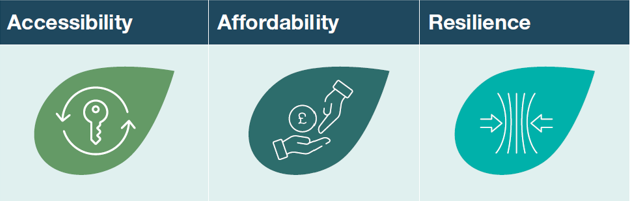
At each stage of our AAR Initiative, we will focus our research and discussions on one pillar in depth, while continuing to seek progress across all three.
- Stage 1: ensuring the accessibility of essential financial services for UK households
- Stage 2: supporting fair affordability and product innovation that widen opportunity
- Stage 3: strengthening resilience and capacity to withstand financial shocks
Further supporting these stewardship efforts is the UK Government’s new Financial Inclusion Strategy, published in November 2025. While we welcome the renewed policy focus, we have identified several areas which believe would benefit from further attention. With this in mind we have made a formal submission to the Treasury Committee’s inquiry on financial inclusion, in which we called for stronger accountability, with particular emphasis on the role of investors and institutional capital in supporting systemic change.
Our first report on the progress of this initiative was recently published, sharing findings from the pilot phase with our building society holdings and outlining where we intend to focus our efforts going forward. Our report Financial Inclusion in the UK: EdenTree’s AAR Initiative can be found here.
Engagement and voting: In brief
From AI’s growing water footprint to banks’ climate commitments, our stewardship activity this quarter focused on where investor pressure matters most.
Addressing the impacts of AI
Across cooling, electricity generation, and chip manufacturing, AI’s total water consumption is expected to grow 11x by 2028. For Investors this presents both risks, such as regulation and reputational harm, as well as opportunities in enablers and water stewardship leaders. Apple Inc. and Alphabet Inc. are two companies that use vast amounts of water and together with the Valuing Water Finance Initiative we are speaking to both firms to push for better management of water-related risks and more ambitious water targets. Most recently we wrote to the Chair of Apple’s Nominating and Governance Committee to press the Board on better oversight of supply chain water risk.
Pressing banks on climate action
Already this year we have seen a number of banks scaling back their climate ambition and rolling back on their fossil fuel financing targets. This is an area we will be monitoring closely, taking escalating action where necessary to encourage banks to stay the course. Banco Santander is one such bank where we noted a weakening of its climate targets and oil & gas policies in February. Combined with a deterioration in the bank's oversight of material climate-related financial risks, we chose to escalate by voting against directors with responsibility for climate governance at their AGM.
Ongoing commitment to Stewardship
We are pleased to confirm that EdenTree has successfully renewed its status as a signatory to the UK Stewardship Code, following the approval of our latest submission by the Financial Reporting Council (FRC) in January 2026. The submission marked the final reporting year under the 2020 Code, ahead of the transition to the updated 2026 framework. As we move into the transition year, we are integrating our Stewardship Code reporting into our Annual Sustainable Investment Activity Report, which will be published in April.
For more examples of our recent stewardship activity head to our quarterly Sustainable Investment Activity and Proxy Vote Reports: https://www.edentreeim.com/insights
On our radar
Topical news and research that has caught the team’s eye:
World enters era of global water bankruptcy
Ahead of World Water Day, the UN warns that the world has entered a state of “water bankruptcy,” with global demand outstripping natural replenishment each year. The report reframes the crisis as a structural imbalance in the water cycle and calls for a fundamental reset in how water is valued, allocated and protected globally1.
The Electrotech Revolution
Ignore the fossil noise, the electrotech revolution is happening: Electrotech has grown exponentially for decades. The difference today is that it’s too cheap to contain and too big to ignore. If current exponentials hold for five more years, global fossil demand falls off its plateau2.
25 years of British offshore wind
In 25 years, the British wind industry has led the world with colossal offshore solutions that can now power 16 million homes annually, boosting local manufacturing across its coastline3.
On point: The cost-benefits of a UK energy transition
A new report from the UK’s Climate Change Committee (CCC) delivers a timely and powerful message in an increasingly volatile energy landscape: the cost of getting to Net Zero by 2050 is likely to be less than the cost of a single fossil fuel price shock.
The CCC tested its Net Zero pathway across a range of scenarios, varying assumptions around technologies, energy demand and fuel prices. The report’s conclusions are striking. The dominant economic risk facing the UK is not the cost of clean technologies, but continued reliance on fossil fuels.
Key takeaways include:
- One fossil fuel price shock: a single price shock of 2022 magnitude could cost the UK as much as the entire net cost of reaching Net Zero to 2050.
- Strong cost benefit case: benefits outweigh costs by 2.2–4.1 times for every £1 invested in Net Zero.
- Avoided climate damage: valued at £40bn–£130bn per year by 2050.
What has particularly caught our attention is the scale of energy losses avoided through the transition. Beyond reducing exposure to international gas and oil prices, clean technologies dramatically cut wasted energy across the system. The CCC finds that losses in a Net Zero energy system are around half today’s level, valued at roughly £30bn per year, compared with around £60bn per year in the current fossil fuel heavy system.
As the CCC concludes, “in all scenarios, achieving Net Zero is a more cost-effective path for the UK economy than continued reliance on fossil fuels, bringing a net benefit to society.”
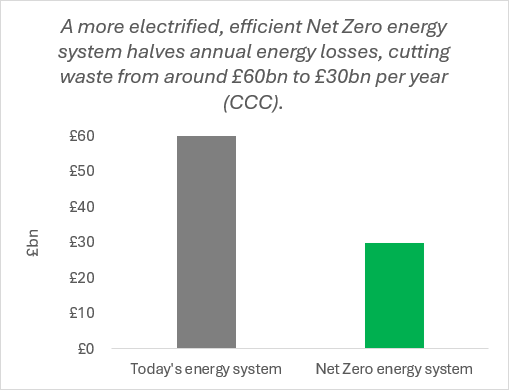
Source: Supplementary analysis of the Seventh Carbon Budget
Sources
About Us
EdenTree is an active investment management house dedicated to sustainable and impact investing – it’s all we do. We have a 35+ year track record in this space, having launched our first ethical fund in 1988.
Our Sustainable Investment Team, made up of our fund managers and sustainability analysts, is united by four core beliefs that guide everything we do. We invest for a better tomorrow, acting as long-term, active investors who focus on businesses making a positive contribution to people and the planet. We invest in quality, combining rigorous investment and sustainability analysis to tilt our focus towards resilient and responsible companies. We invest at sustainable valuations, always considering the long-term value an investment can deliver for our clients. And we engage for change, maintaining an active programme of engagement and voting to ensure businesses are operating responsibly.
As of February 2026, every EdenTree fund carries an FCA Sustainability Disclosure Requirements (SDR) Sustainability label, reflecting the consistency and rigour that underpins our approach to sustainable investment. Our commitment to excellence in sustainable investing is further portrayed by our award wins, reflecting our leadership in sustainable finance and our inclusive culture. In 2025, we were awarded Best Ethical Investment Provider at the Investment Life & Pensions Moneyfacts Awards for the 17th year running. We also celebrated winning Best Sustainable Fund Launch at the Sustainable Investment Awards 2025 for our Global Sustainable Government Bond Fund. In addition, we were Highly Commended for Investment Group of the Year for Diversity and Inclusion at the Women in Investment Awards 2025.
EdenTree is based in the heart of the City of London, but our team serves the professional investor community across the entirety of the UK, with dedicated regional sales managers providing exceptional levels of client support.
EdenTree is part of the Benefact Group – a charity owned, international family of specialist financial services companies that give all available profits to charity and good causes.
For investment professionals only. The value of an investment and the income from it may go down as well as up and the investor may not get back the amount invested.
For investment professionals only. This financial promotion issued by EdenTree Investment Management Limited (EdenTree) Reg No. 2519319. Registered in England at Benefact House, 2000, Pioneer Avenue, Gloucester Business Park, Brockworth, Gloucester, GL3 4AW, United Kingdom. EdenTree is authorised and regulated by the Financial Conduct Authority and is a member of the Investment Association. Firm Reference Number 527473. MKT001230